


















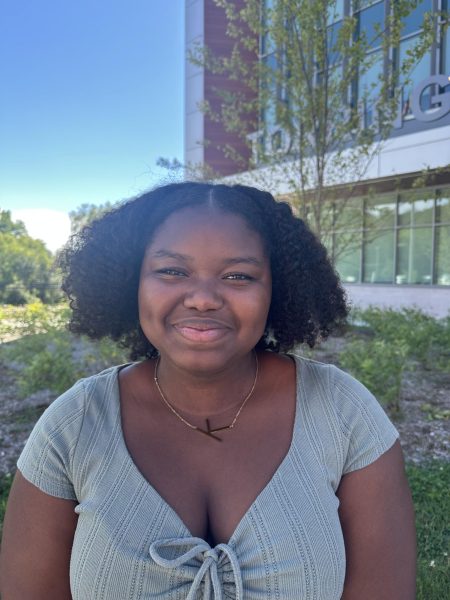
Kajeda Fraser is a current senior attending THS. Kajeda is very active in her school as well as in the Torrington community. She is currently participating in Student Council as Senior Class President, Black Student Union as President, the Model United Nations Club as Ambassador of Finance, and on the Track & Field team. In her community, she volunteers with the YMCA year-round, with the Torrington Youth Service Bureau during Christmas time, and serves on the Mayor’s Committee on Youth as President during the school year. After high school, she plans to attend UCONN in the fall to study finance. In this newspaper, her goal is to write about more worldly topics that will interest the students of THS. In her free time, she enjoys trying out new recipes and reading “Chick Lit.”
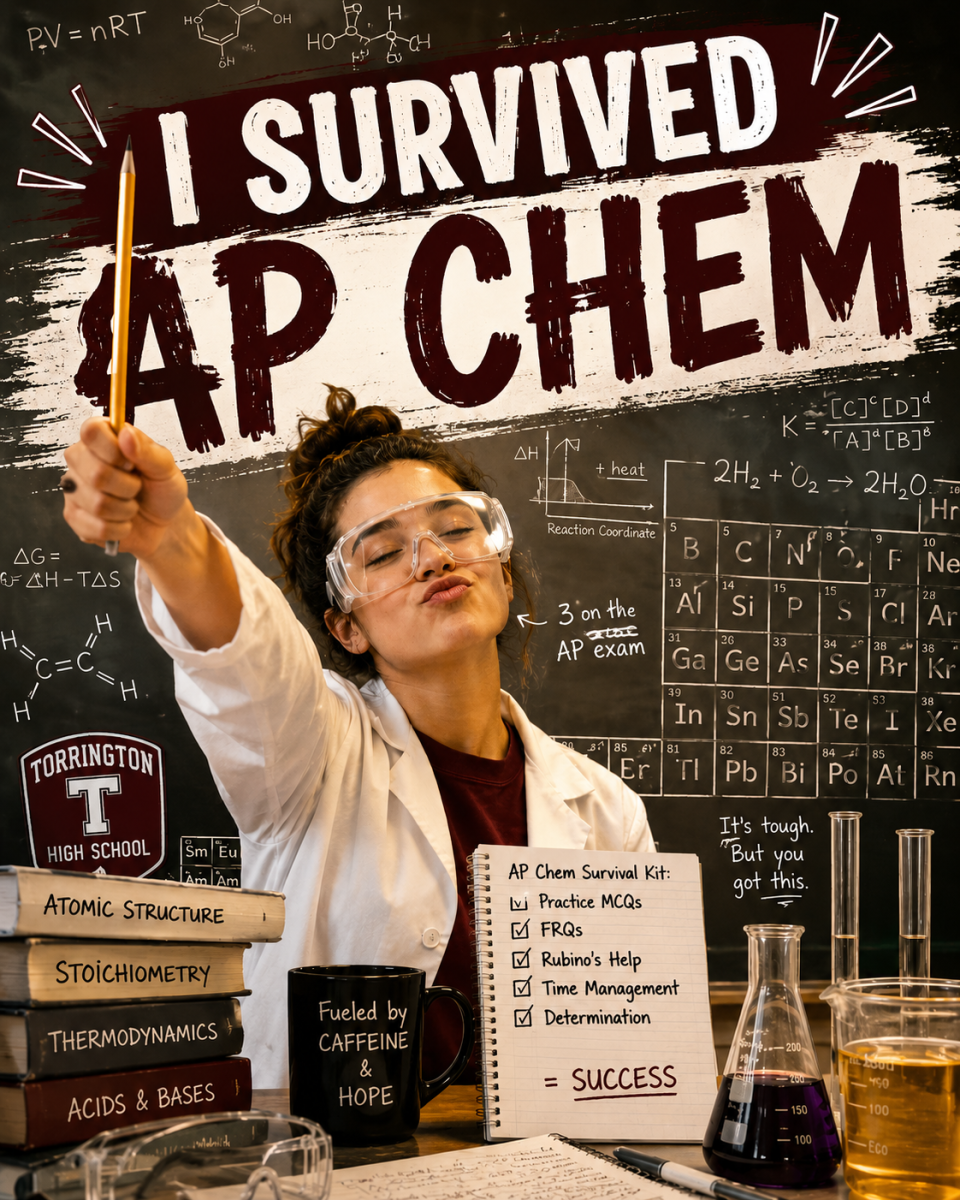
If you’ve heard the rumors about AP Chem, they’re true and honestly a bit understated. My name is Kajeda Fraser, and I’m a senior here at Torrington High. I took AP Chemistry during my junior year.
When people say junior year is the hardest year of high school, believe them. Taking AP Chem did not make it any easier.
AP Chemistry is equivalent to the class General Chemistry I & II in college. If you score a 4 or higher on the AP test, you can earn up to 8 college credits (for reference, I earned a 3 on the test). It is a difficult class and is widely regarded as one of the most content-heavy AP classes.
Now you might wonder what this course entails, and if it’s really worth taking. AP Chemistry starts with foundational topics like atomic structure and properties, but quickly builds to more difficult concepts, ending with thermodynamics. The key to success is mastering the basics. Everything builds from them.
For you underclassmen who have taken Chemistry Honors and think you’re ready for this class – you are.
Personally, I took Chem H as a sophomore. As Chemistry teacher Rubino told me, “When you took the class, it only covered part of Unit 1.”
He has recently restructured his Chem Honors classes to introduce Lewis dot structures, include more stoichiometry, and hone in on conversion skills. This will help you in later units.
You should’ve started reviewing yesterday. Around this time last year, we had finished learning new topics. This gave us about three weeks in class to go over earlier units and practice questions.
With your newfound class time, this should be the time to practice FRQs and MCQs. For those who don’t know, FRQ stands for Free Response Question and MCQ stands for Multiple Choice Questions.
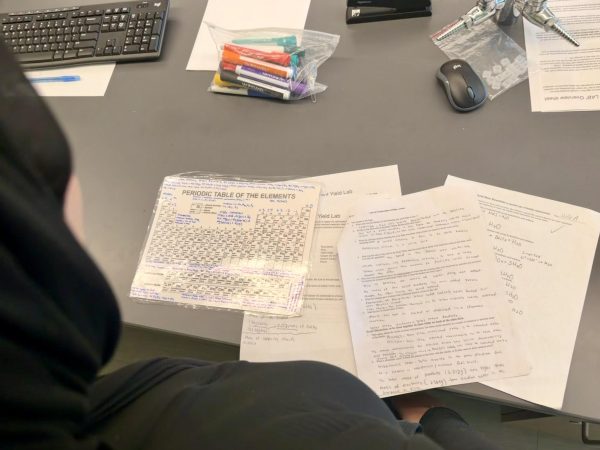
As I studied and practiced for the test, I found that I was stronger in FRQs. These questions call for concise reasoning. Overexplaining could hurt you, especially if it’s incorrect.If I’m being honest, I was happy to get 50% on a practice MCQ.
If you find yourself still struggling with concepts, turn to my personal favorite YouTuber, Jeremy Krug. Krug is a great educator who reinforces concepts through unit reviews or hour-long example based videos.
You cannot rely solely on class time, so he is a great alternative to Mr. Rubino. Especially if you’re a procrastinator like me, those 10-minute reviews will be fresh in your mind on test day!
As you’ve probably heard before, time management is key! Although it is a challenging class, with the right mindset and preparation, you can succeed.